Showing posts with label fantasy. Show all posts

Saturday, July 25, 2015

Who is the Raven King? - Jonathan Strange & Mr. Norrell's Mysterious Monarch


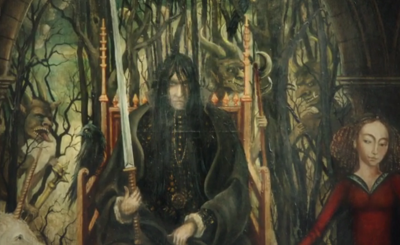
For the last seven weeks, Jonathan Strange & Mr. Norrell, otherwise known as the best fantasy series since The Lord of the Rings, has been airing in the United States (read my recaps here). The finale airs tonight, and will (spoiler if you haven't been paying attention) at last reveal the Raven King, John Uskglass, ancient ruler of both England and faerie.

Both the titular characters are inextricably bound to the Raven King, willing or no. Mr. Norrell is a hidebound conservative, and looks down on the Raven King's "unrespectable" magic, but he owes a debt to the earlier magician's efforts. On the other hand, at this point in the series, Norrell's erstwhile pupil Jonathan Strange desires to summon Uskglass in order to employ the sorcerer's power to rescue Arabella Strange.

And who is the Raven King, exactly? The closest literary parallel may be Watership Down's trickster hero El-ahrairah. Both characters loom mythically large, but they are political, not religious, heroes - incarnations of what a country or a people should be, not a soul. They are Robin Hood, or perhaps George Washington (don't tell me he hasn't become a bit mythical), rather than Jesus.

(Some spoilers, obviously.)

Friday, March 13, 2015

The Music of the Spheres - Terry Pratchett

Terry Pratchett was a master of the art of British comedy. What's more: he was one of the great fantasy novelists and satirists of the 20th Century. In being all these things, he is - at least in America - often unfairly overshadowed by specialists in each. He created a famous black-haired, bespectacled young wizard who goes to a school in a castle, and then a young upstart came along and stole his thunder. A successor to Monty Python and P.G. Wodehouse, a contemporary of Douglas Adams, he was a bit more serious than any of them. The breadth of his invention rivaled Dickens, but then, he wasn't Dickens. And of course, Pratchett was far too funny to be taken seriously as a satirist.

Saturday, December 21, 2013

Doctor Who is a God - Science Fiction and the Worship of Man

[You know how sometimes you write dumb stuff when you're younger and then get over it? That's basically the definition of this piece. I'm keeping it up for human interest, but I'm an enormous Doctor Who fan now.]

I've come to two conclusions about Science Fiction. First, if there's any chance of enjoying things like Star Wars, Star Trek, and Doctor Who, one must embrace the inherent campiness of it. Chewbacca? Alien octopuses in robotic shells that have no emotion but hate? Yes, please. The other conclusion? Stay tuned.

Over the last few weeks, I've watched enough New Doctor Who episodes to get a pretty fair grasp of the show. I know not to call him Doctor Who, but The Doctor. I can hold my own in a conversation that throws around terms like "Cybermen" and "Daleks" and "Time Lords" and even (ugh) "Slitheens." 

For those of you who don't know - Doctor Who is about a 900-year-old shape-shifter who travels through space and time in a ship shaped like a 1950's police-box and saves various realities from malign species, accompanied by amusing, usually female sidekicks. He never dies, but regenerates every few years into another member of RADA. And yes, it's about as campy as it sounds, but there are moments when it transcends its genre.

Here's the thing: I really wanted to like this show. I really did. And I did like it, through the first season. It was season two that killed it for me. (I am compelled to add, however, that season 3 pulled me back into the fold, thanks mostly to Donna Noble.) After what I realized watching the second season, it can never be quite the same.

Monday, July 22, 2013

Never Say Die - Modernity and Morality - Part 2


Part 1

As a culture, we either avoid death or surrender to it—we are either blind optimists or self-centered pessimists. Speaking of death is often described as morbid. Speaking of it ceaselessly is either depression or being highly artistic, depending on one’s college degree. The optimists find themselves, in their last moments, scrabbling madly for a hold on life, staring at the wall in wide-eyed, hyperventilating terror. The pessimists go into a dark room and blow their brains out. What is the answer? What is the correct way to deal with death?

On one hand, there is no avoidance.

Death is the destiny of every man; the living should take this to heart.
Ecclesiastes 7:2, NIV

But…

O death, where is thy sting? O grave, where is thy victory?
1 Corinthians 15:55, KJV

Death is not there to be avoided, it’s there to be beaten—it has been beaten. Jesus took death down. Like a line-backer. This is the truest realism, not the despairing acceptance of meaninglessness. If it’s cowardice to avoid death, is it not cowardice to surrender to it? Is it not stupid to eschew all good things because of a hyped up idea that it’s sentimental? Isn’t that just intellectual dishonesty? Sure, it’s wrong to accept an idea because it makes you feel good, but isn’t it also wrong to reject an idea because it makes you feel good?

Saturday, June 29, 2013

Never Say Die - Modernity and Morality - Part 1


Jeeves and Wooster
“Stephen Fry and Hugh Laurie shouldn’t age,” says my Dad, leaning against the kitchen counter. “Seeing them get old…it just doesn’t…it’s weird.”

Back in the ’90s, the two British actors co-starred in Jeeves and Wooster. Fry and Laurie played, respectively, the unflappable, omniscient valet, Jeeves, and his dimwitted, talkative employer, Bertrum Wilberforce Wooster. The stories are set in an idyllic pre-war atmosphere, where the greatest ill that can befall a man is ridiculous romantic dilemmas or bogus get-rich-quick schemes. Let’s be honest, it’s pure escapism—albeit escapism with lively wit, brilliant plotting, and hilarious (if somewhat one-dimensional) characters. No one ages and, of course, no one dies.

That’s why it’s so weird to see old Fry and Laurie. I had a similar reaction to seeing Anthony Valentine in a modern movie. I’d had a crush on him in the 1975 TV show Raffles…and suddenly, he was in his seventies. He's old enough to be my grandfather.

Why this violent reaction, this jerking back from reality?

Monday, June 17, 2013

Bill Whittle on The Lord of the Rings

It's been sixteen days since I've posted - about the longest interval in my year of blogging. In the face of this deplorable neglect, I started to get desperate. Thus, I'm pulling out one of my emergency blog subjects: The Lord of the Rings.

Bill Whittle is one of my favorite political commentators. He works for PJTV.com, and is involved in three internet TV shows - hosting Afterburner and The Firewall and co-hosting Trifecta with Stephen Green and Scott Ott. He consistently turns out classy, intellectual commentary on current events. He'd mentioned Tolkien several times, so I was curious as to what the story was.

His take on it, somewhat predictably, involves politics. I don't entirely agree with him, but it's certainly a credible and important interpretation.

The relevant section is from 39:00 to 48:50.

Enjoy:


Longish

Wednesday, January 9, 2013

The Dramatized Addison Walk


Your average Christian is going to know who C.S. Lewis is.

Your slightly less average Christian will know who J.R.R. Tolkien is.

A rather odd Christian will know that Lewis and Tolkien knew one another and were members of an Oxford-based club, the Inklings.

It takes a really weird Christian to know that Tolkien was one of the major influences on Jack Lewis's conversion.

Congratulations, you are now a really weird Christian. And if you want to be a fanatic, C.S. Lewis was nicknamed after a childhood neighbor's dog, Jack. (This calls to mind a certain Indiana Jones).